
It is a fair question, and a common one. You have a yard ramp. You have pallet jacks. Can you use them together? The real question behind the search is whether you can use a pallet jack on a loading ramp safely, and the short answer is that you usually cannot. The reason matters more than most buyers realize before they purchase. The limitation is not a matter of effort or technique. It is a matter of grade, and grade is fixed by physics.
The Grade Problem
A yard ramp creates a slope, and the steepness of that slope depends on two things: the height it has to reach and the length of the ramp. A standard truck bed sits 48 to 52 inches off the ground, so every ramp has to climb roughly four feet. A longer ramp spreads that climb over more distance and produces a gentler grade. A shorter ramp compresses it and produces a steeper one. In practice, most yard ramps run between a 7 and 15 percent grade.
Now put pallet jacks against those numbers. A manual pallet jack is generally rated for grades below 7 percent. A powered pallet jack typically tops out around 10 percent. Set those limits next to a 7 to 15 percent ramp and the conflict is obvious. At common yard ramp grades, most pallet jacks are already at or past their safe operating limit before the load is even factored in. This is not a brand or model problem. It is the grade itself.
A quick example makes the grade concrete. To reach a 50-inch truck bed at a 10 percent grade, a ramp needs roughly 42 feet of run — squarely inside the 30 to 50 foot approach range most yard ramps require. Shorten that ramp to fit a tighter yard and the grade climbs. Stretch it for a gentler slope and the footprint grows. The buyer is always trading grade against length, and a pallet jack sits on the wrong side of that trade at almost every practical ramp length.A surface-mounted dock lift such as the Forklift Pro® Speed-Lift works within a 20 foot footprint, because it raises freight straight up rather than requiring a run-up. The grade problem and the footprint problem are two sides of the same ramp constraint — both disappear when the incline does.
What Happens When You Push a Loaded Pallet Jack Up a Slope
The physics are simple and unforgiving. On a manual pallet jack, the operator provides the force. On a flat floor, that force only has to overcome rolling resistance. On an incline, the operator also has to overcome gravity acting on the entire load. A 2,000-pound pallet on a 10 percent grade pushes back with a substantial fraction of its weight, and a person is the only thing holding it.
Going up, that means the operator fights the full resistance of the load on every foot of the climb. Coming down is worse. Gravity now works with the load instead of against it, and the operator is in front of a 2,000-pound pallet that wants to accelerate downhill. A momentary slip, a wet patch, or a loss of grip turns a routine move into a serious incident. This is why standard safety practice treats inclined-surface operation with loaded equipment as a distinct hazard rather than a normal task. A pallet jack on a ramp puts a worker in exactly that position, every load, every cycle.
Some operations try to manage the descent with a second worker, one steering and one holding the load back. That does not remove the hazard. It adds a person to it. The underlying issue is that a pallet jack has no powered braking sized for a loaded descent, and human strength is the only thing between the load and the bottom of the ramp. No amount of technique changes that on a steep grade.
The Forklift Workaround and What It Costs
Most facilities that run into this limitation end up solving it with a forklift. Either they drive a forklift up the ramp to carry loads a pallet jack cannot, or they use the forklift to lift the pallet jack and its load into the trailer. Both work. Both also add handling.
Running a forklift at the ramp for pallet jack loads doubles the equipment at a single dock point and adds steps to every move. It introduces a second machine, a second operator, and the coordination between them, all to move a load the pallet jack was supposed to handle on its own. The cost is rarely a line item. It shows up as slower loading, more labor at the dock, and added wear and traffic in a space that may already be tight. A workaround that was supposed to be occasional often becomes the standing process, and the operation quietly absorbs the overhead.
The workaround also competes for space and introduces a distinct safety hazard. A forklift staged at the ramp to handle pallet jack loads occupies part of the same approach the ramp already consumes, and it operates in the same envelope as the pedestrian pallet jack operators it is there to assist. Forklifts and foot traffic sharing a tight, loaded ramp approach is a recognized mixed-traffic hazard — the kind of condition OSHA loading area requirements are specifically designed to separate. A workaround that was supposed to be occasional creates that condition on every load.
What a Dock Lift Changes
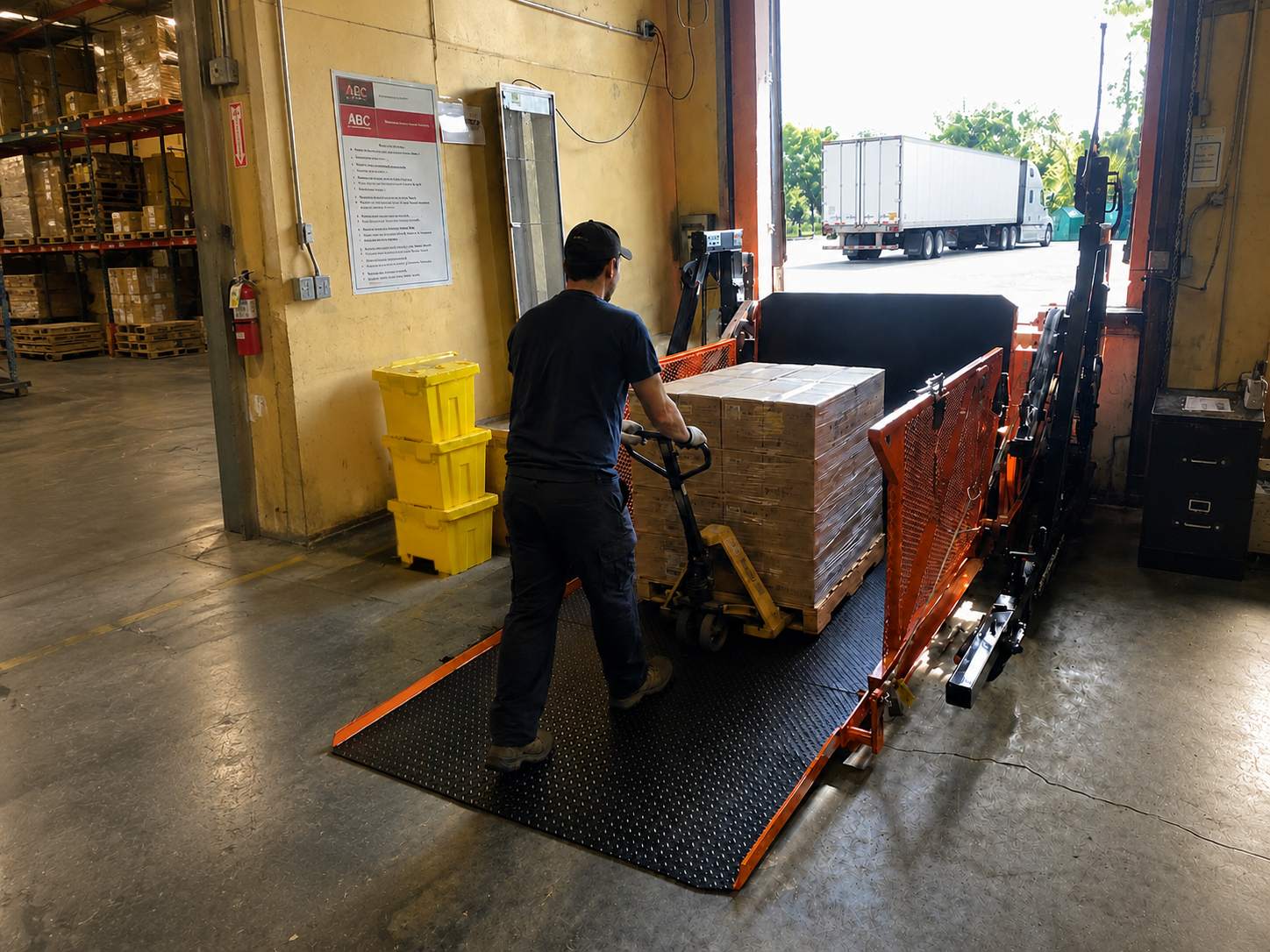 A surface-mounted dock lift removes the incline entirely. Instead of asking a pallet jack to climb a slope, it raises the load straight up. The Forklift Pro® Speed-Lift platform is level at ground, level at truck height, and level everywhere in between. An operator rolls onto the platform at grade — whether on a pallet jack, a hand cart, or a small sit-down forklift — raises to truck height in 9 seconds, and rolls directly into the trailer across an automatic bridge. There is no grade to fight and no second machine required. The Forklift Pro® is a dock alternative: it provides the same truck-to-ground loading capability as a permanent dock, without the construction, the slope, or the 30 to 50 foot approach a ramp requires.
The Forklift Pro® handles the full range of common dock equipment such as hand carts, dollies, pallet jacks, and small forklifts with a 15,000 lb capacity, so the same lift point serves every load type the operation runs. For facilities whose dock work is primarily pallet jacks, hand carts, and light freight with no sit-down forklift at the dock, a MyDock® Speed-Lift is the more direct fit. It delivers the same level-surface advantage at 6,000 to 8,000 lb, designed specifically for hand carts, pallet jacks, and cart-based operations — the operations that were walking loads down ramps before they found a better answer. In either case, the pallet jack does the job it was built for, on a flat surface, with no incline and no second machine.
The lift also changes the site logistics. It anchors to a flat pad and connects to standard power, typically in a single day, and it can be unbolted and relocated if the operation moves. For a facility that adopted a ramp mainly because a pallet jack could not reach truck height, the lift solves the original problem directly rather than building a workaround around it.
When a Yard Ramp Is Still the Right Call
This is not an argument that yard ramps have no place. If your operation runs forklifts only, you have the yard space for a 30 to 50 foot approach, and you do not load in winter weather, a yard ramp may be exactly the right fit. The portability and lower upfront cost are real advantages for the operations that match its profile.
The point is narrower and more useful than ramp versus lift. If your operation depends on pallet jacks, a yard ramp’s grade is a constraint you should understand before you buy, not after. The question is not whether a pallet jack can technically get up a ramp. It is whether you want your workers doing that, loaded, every day, and what the workaround costs when they cannot.
Find the Right Loading Setup for Your Equipment
If your operation runs both forklifts and pallet jacks, or works in tight quarters or cold weather, it is worth understanding what a level-surface lift handles differently. A site assessment maps your specific equipment mix to the right solution. Complete a site assessment or call (800) 221-4339 to talk it through. The Lift Finder Tool is a quick way to compare models first.
FAQs
Can you use a pallet jack on a yard ramp?
In most cases, not safely. Manual pallet jacks are rated for grades below 7 percent and powered pallet jacks for about 10 percent, while most yard ramps run a 7 to 15 percent grade. At those grades, a pallet jack is at or past its safe operating limit. Yard ramps are designed for forklifts, not pallet jacks.
Why can a pallet jack not go up a steep ramp?
On an incline, the operator has to overcome gravity acting on the full weight of the load, not just rolling resistance. A loaded pallet jack on a slope is hard to control going up and can accelerate dangerously coming down. The steeper the grade, the larger that force, which is why pallet jacks carry low grade ratings.
What is the safe grade for a powered pallet jack?
A powered pallet jack typically tops out around a 10 percent grade, and a manual pallet jack below 7 percent. Most yard ramps exceed those limits depending on length and the truck height they reach. A level loading surface removes the grade question entirely.
How do you load pallets without a forklift or a ramp?
A surface-mounted dock lift raises a pallet jack and its load straight up to truck height on a level platform, with no incline to climb and no forklift needed. The operator rolls onto the platform at ground level, raises to truck height, and rolls into the trailer. This is the most direct way to handle pallet jack loads at a facility without a dock.
Can one lift handle both forklifts and pallet jacks?
Yes. Because the platform stays level, a dock lift such as the Forklift Pro® Speed-Lift handles the full range of common warehouse equipment — hand carts, dollies, pallet jacks, and small forklifts with a 15,000 lb capacity. For pallet jack and cart-only operations, the MyDock® Speed-Lift provides the same level-surface advantage at 6,000 to 8,000 lb. Either way, the grade is gone, and so is the need to route every load through a forklift. Use the Dock Lift Selector Tool to match a model to your equipment.